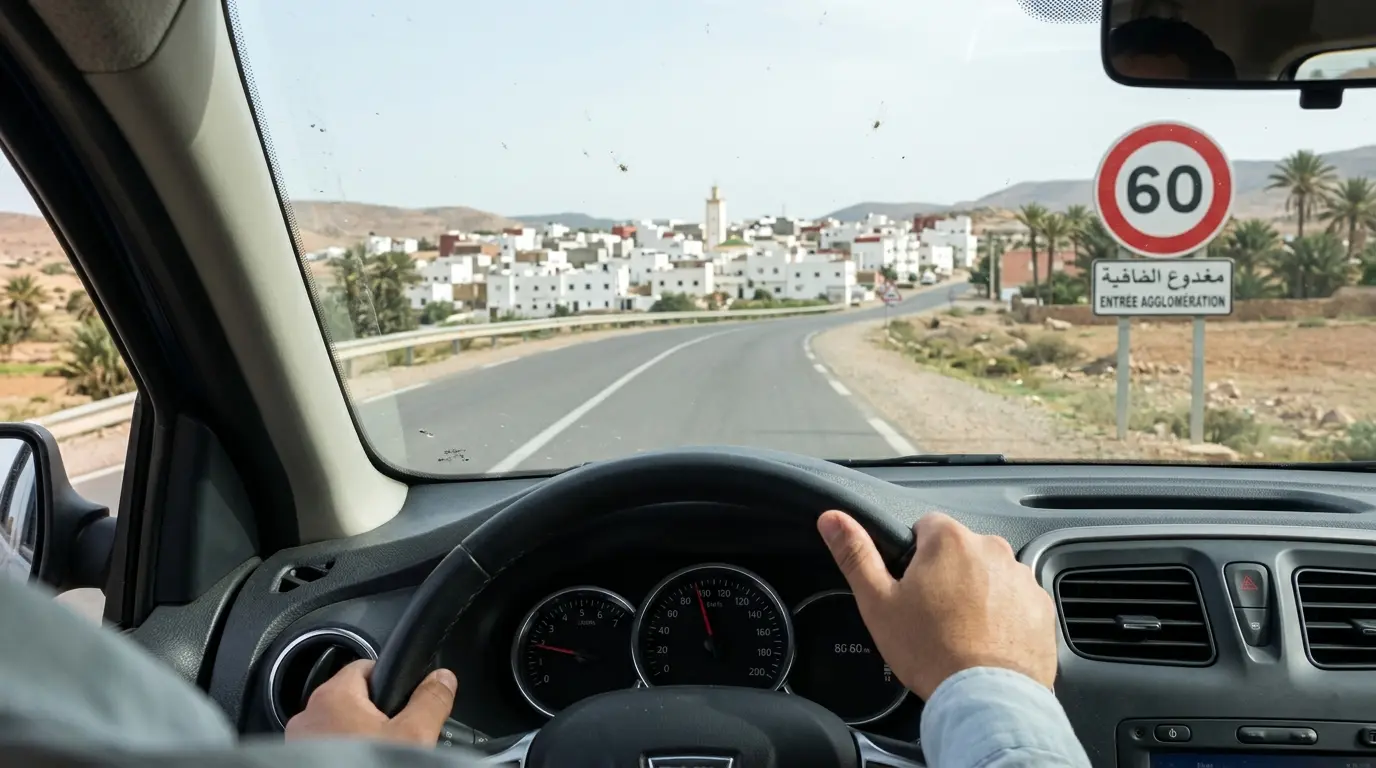
A couple checked in with us recently after their Agadir airport pickup. They'd been fined 400 dirhams within the first hour of driving for going 65 km/h in a 60 km/h zone. Five kilometres over the limit. The officer was polite, professional, and completely unmovable. They spent the rest of their two-week trip watching their speedometer obsessively. They didn't get another fine. But they also didn't enjoy the driving as much as they could have.
The right preparation takes ten minutes to read and eliminates the problem entirely. Here's what you need to know before you leave Agadir airport.
What You'll Learn in This Guide
- The exact speed limits that apply on different road types around Agadir
- How Morocco's radar enforcement works in 2025 and why it's stricter than ever
- The specific situations where limit changes catch drivers off guard
- How fines work, what they cost, and how to pay correctly
- The driver warning system that local Moroccans use that tourists benefit from too
Speed Limits in Morocco: The Numbers That Matter
Speed limits are rigidly enforced: 60 km/h in cities, 100 km/h on national roads, and 120 km/h on highways. Even 5 km/h over gets fined.
That last sentence is the one that surprises most foreign drivers. The tolerance buffer that exists in many European countries, the unspoken understanding that 75 km/h in a 70 zone won't attract attention, does not apply in Morocco. The limit is the limit.
For driving around Agadir specifically:
Within Agadir city: 60 km/h is the standard urban limit. On specific busy boulevards and near schools, lower posted limits of 40 km/h apply and are enforced.
The airport road (P1714 and N1): The approach road from the city to Agadir Al Massira Airport transitions between urban and national road categories. Watch for limit signs as you leave the city boundary as the applicable limit changes at that point.
The A7 highway toward Marrakech: 120 km/h is the motorway limit. Toll plaza approach zones post lower limits that apply strictly in that section.
National routes N1 and N10: 100 km/h applies on open sections between settlements. The limit drops to 60 km/h as you enter any town or village, often with very little warning distance between the open road and the reduced zone.
How Radar Enforcement Works in Morocco in 2025
Morocco's speed enforcement system has become significantly more sophisticated and it's worth understanding what you're dealing with before you drive.
There are many fixed cameras, notably along the toll roads and on good highways out of the main cities. Mobile speed traps are even more prevalent.
Until 2025, fixed speed cameras in Morocco monitored only one direction of traffic, leaving blind spots exploited by reckless drivers. Since June 2025, the bidirectional system ensures symmetrical coverage, reinforcing deterrence. The advanced radars capture offenses in real time, in both directions, and send the data to an automated control center. This means the older tactic of slowing for a known camera and accelerating immediately past it no longer works on routes fitted with the new system.
The new trend is installing large birdhouse-looking boxes on short poles. These boxes have both radar and cameras in them, placed in random areas and regularly moved. If you speed past one of these boxes, it takes your picture along with your current over-the-limit speed and sends it to the cell phones of the police. As you eventually get to an official police stop, they are already looking for your car description and plate number. You will get a ticket right there and then.
Moroccan police officers use speed cameras often referred to as trafipax, which they deploy in unsuspecting locations. Motorists may find themselves cruising along a seemingly empty stretch of road, only to be flagged down by a Moroccan officer who proceeds to show them a photograph of their vehicle captured by the speed camera, displaying exactly how much they exceeded the speed limit.
The Limit Change Problem: Where Drivers Get Caught
The single situation that produces the most fines for foreign drivers in Morocco isn't blatant speeding on open roads. It's the rapid succession of limit changes on national routes passing through settlements.
You'll be cruising at 100 km/h on a national road when suddenly the limit drops to 60 km/h, then 40 km/h, then back up to 100 km/h within a few kilometres. These changes often indicate military installations, unmarked turnoffs, or checkpoint zones. Pay attention to signage even when the reason for the change isn't obvious.
The maximum speed limit signs sometimes change three times within a span of 80 metres, scattered sporadically throughout the road. This seemingly erratic placement of speed limit signs can catch even the most vigilant drivers off guard.
You can count on the police having a radar gun patrol located just behind a speed drop. This is the pattern that catches people. The limit drops from 100 to 60 as you approach a village. The police position themselves 200 to 400 metres past that sign where drivers who haven't fully braked are still carrying too much speed. It's not a trick. The sign was there. The limit was posted. The camera or officer was simply in an effective position.
The practical rule: when you see a speed limit drop sign, brake immediately to that speed before you pass the sign, not gradually after it.
The Fine Structure and How to Pay
Fines start at 300 MAD. If you are doing more than 20 km over the limit it becomes 500 MAD, more than 30 km over the limit is 700 MAD and possible confiscation of the vehicle.
Fines are paid in cash at the checkpoint, on the spot. The ticket process is uneventful and professional. Always request and keep a receipt. A legitimate police fine comes with a numbered receipt that records the officer's details, the violation, and the amount paid.
Moroccans apparently will negotiate this down, but that is simply a bribe and given the low cost and high consequences it is totally not worth it. Just pay the ticket. Attempting to negotiate a fine creates a different kind of problem. Pay the stated amount, take the receipt, and move on.
Keep 400 to 500 MAD in small notes accessible in the car throughout your trip. Not because you plan to speed, but because having the cash available means a stop at a checkpoint is resolved quickly and calmly rather than creating a secondary problem about change.
The Headlight Warning System
If you see other drivers flashing their headlights at you, it usually means there is a police checkpoint or speed trap ahead. Moroccan drivers help each other out this way, and tourists benefit from this informal warning system too.
Mobile speed traps are very prevalent but often other drivers will warn you by flashing their lights. This system is consistent enough to be reliable. Oncoming drivers flashing their headlights in daylight is the signal. It means slow down and check your speed immediately. The camera or checkpoint is typically within the next one to three kilometres.
This isn't a guarantee and it doesn't mean the limit doesn't apply when no flash comes. It's an additional layer of awareness that experienced Morocco drivers use as a supplement to their own constant attention to signage, not a replacement for it.
Navigation Apps and Speed Camera Alerts
Both Waze and Google Maps function well on Moroccan roads and include speed camera alerts from user-reported data. There are many fixed cameras along toll roads and on good highways out of the main cities. The fixed camera locations are relatively well-documented in both apps.
The limitation is mobile radar units. These boxes are placed in random areas and regularly moved. Mobile units change position daily and community-reported data in navigation apps lags behind actual deployment. Don't rely on app alerts as your primary protection against mobile radar. Driving to the posted limit consistently is the only reliable approach.
Keep your phone mounted and the navigation app running with audio alerts active throughout your rental. It adds a layer of awareness. It doesn't replace watching the road and the signs.
Questions We Get Asked All the Time
Can the police fine me for going 5 km/h over the limit in Morocco?
Yes. Even minor violations of 5 to 10 km/h over the limit result in 300 to 400 MAD fines. This is not a theoretical possibility. It happens routinely to tourists in rental cars. Drive to the posted limit.
Do Moroccan speed cameras catch rental cars specifically?
The cameras don't distinguish between rental and privately owned vehicles. However, rental cars with foreign plates are sometimes subject to more checkpoint attention because officers know tourists are less likely to contest fines. The correct response is simply to drive legally and the issue never arises.
What happens if I don't pay a fine at the checkpoint?
Fines are payable on the spot in Morocco. Refusing to pay or being unable to pay creates a significantly more complicated situation than simply having the cash available. In some cases officers may retain your driving licence until payment is made. Carry enough cash to cover a potential fine throughout your trip.
Is Waze reliable for speed camera warnings in Morocco?
For fixed cameras on major routes, Waze data is reasonably reliable. For mobile radar units that move daily, it lags behind. Use it as a supplementary tool alongside consistent attention to speed limit signs rather than as your primary protection.
Does LiloxCars report fines incurred during the rental to customers?
Any traffic fines issued during your rental are your responsibility as the driver. If a fine is processed after the rental ends and reaches us, we'll contact you directly. The cleanest approach is driving legally throughout your rental so fines never arise.
The Speedometer Is Your Most Important Dashboard Gauge in Morocco
Morocco's roads are genuinely enjoyable to drive. The A7 highway is smooth and well-maintained. The coastal routes are scenic. The mountain passes are spectacular. None of that enjoyment requires exceeding posted limits, and the enforcement environment makes staying within them the only sensible approach.
Watch the signs, brake immediately when limits drop, listen for headlight warnings from oncoming drivers, and keep cash for a potential fine even if you never need it. If you want to discuss any specific route you're planning from Agadir, you can send us a WhatsApp message before your trip and we'll give you direct local knowledge on that road.