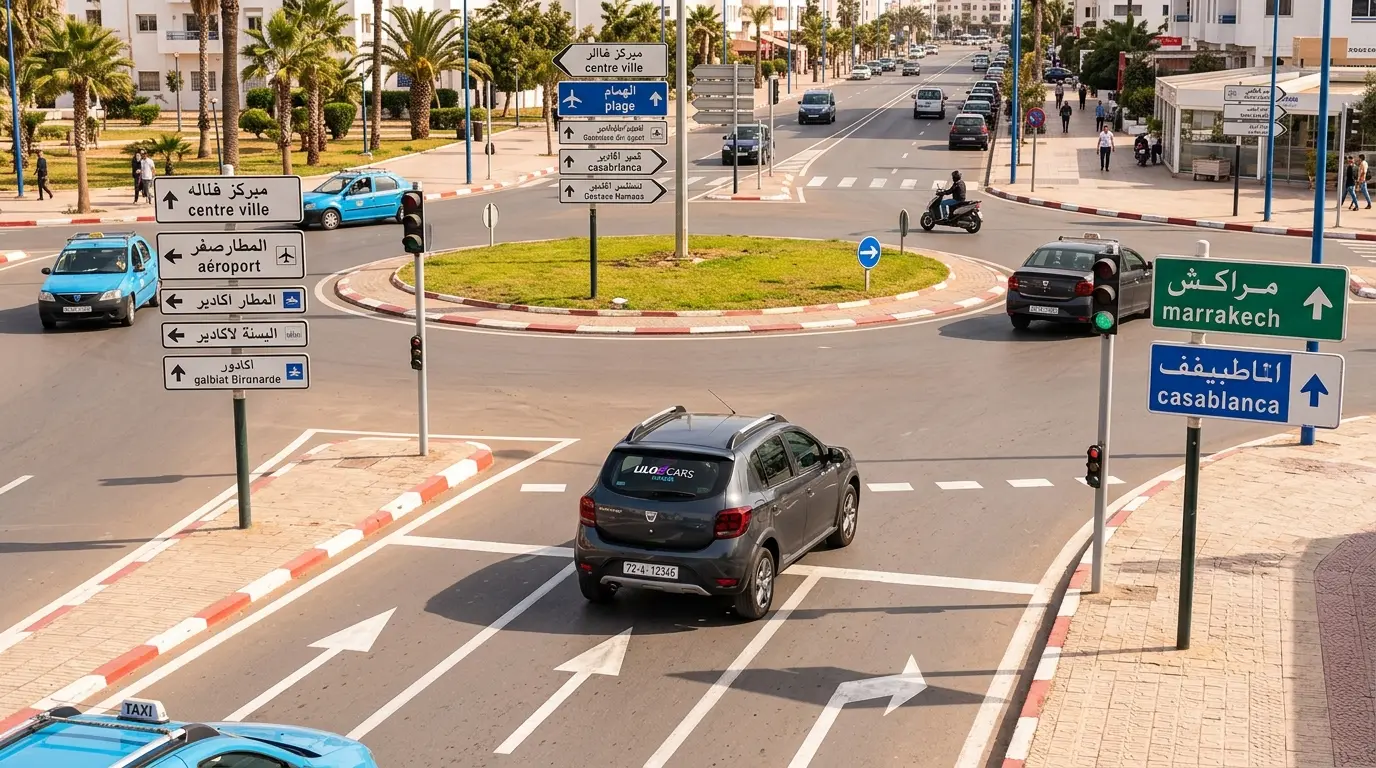
Most first-time drivers in Morocco report the same experience. The roads are better than expected. The scenery is extraordinary. And then they hit their first traffic-light roundabout in Agadir and completely lose their bearings about who has priority.
Morocco's road rules are broadly similar to European systems, with enough specific local variations to catch out drivers who assume they already know the rules. This guide covers everything that actually matters for a tourist driving from Agadir: roundabout priority, speed limits, road signs, police checkpoints, and the driving behaviours that surprise visitors most.
What You'll Learn in This Guide
- How roundabout priority works in Morocco including the traffic-light exception
- Speed limits and how strictly they're enforced
- What Moroccan road signs look like and how to read them
- Police checkpoints: what to expect and how to handle them correctly
- The local driving behaviours that catch foreign drivers off guard
Which Side of the Road and Basic Rules
Morocco drives on the right-hand side of the road, the same as in most of Europe, the United States, and other countries. Give way to traffic coming from the right at intersections unless indicated otherwise by signs or traffic signals.
The right-hand drive rule is the starting point that makes Morocco immediately familiar to most European and American visitors. The right-of-way from the right rule at unmarked intersections is the same convention used across continental Europe and feels natural to drivers from those countries.
Wearing seat belts is mandatory for all occupants of a vehicle, both in the front and rear seats. Using a mobile phone while driving is prohibited unless you are using a hands-free device. Both rules are enforced at checkpoints. Don't give a police officer an easy reason to stop you.
Roundabouts: The Rule and the Exception That Catches Everyone
Roundabouts are where Morocco's road rules cause the most confusion for foreign drivers, and there's a specific Agadir situation worth knowing about before you encounter it.
The standard rule is clear. Roundabouts without traffic lights: if you are on it, you have priority until you leave it. If you are about to enter it, do so when it is possible or when no one comes your way. On roundabouts, you must give way to vehicles already circulating within the ring. This matches the European convention that most visitors are familiar with.
The exception is the traffic-light roundabout, and this is where it gets specific. Roundabouts with red lights are very special hybrids in vogue in Morocco. Even if you are already on the roundabout, you must give way to vehicles that receive the green light. One of these traps is in Agadir. So double your attention. The local police are intractable, which is particularly appreciated by tourists who are not informed about this specialty.
Unlike most countries, vehicles entering with a green light have priority over those already in the roundabout. Read that twice. If you are already on a traffic-light roundabout and a vehicle entering has a green light, you must stop and let them in. This is the direct opposite of what most drivers instinctively do.
Roundabouts are all anti-clockwise. If you have the green light as you approach the roundabout, continue onto the roundabout, but stop on the roundabout before you get to oncoming traffic, which obviously has the green light too. You will need to wait until the light changes to continue.
The practical approach at any Agadir roundabout: look for traffic lights before you enter. If there are lights, treat the roundabout like a signalised intersection and follow the light sequence. If there are no lights, vehicles already on the roundabout have priority and you yield before entering.
Speed Limits and How They're Enforced
Morocco's speed limits are straightforward. The enforcement is strict enough to warrant taking them seriously.
Speed limits are 60 km/h in urban areas, 80 to 100 km/h on secondary roads, and 120 km/h on highways. Within Agadir city itself the relevant limit is 60 km/h unless lower limits are posted locally.
Moroccan authorities are strict about this rule. Exceeding the speed limit by just 5 km/h can result in a fine. The police take speed limits very seriously here. Even going 3 to 4 km/h over the limit can result in a fine. Keep small change handy for potential fines, around 400 MAD.
The fine for missing a red stop sign is 700 MAD. These are real fines that are routinely issued to tourists. The combination of strict enforcement and low tolerance for marginal excess means the correct approach is to drive to the posted limit rather than assuming a buffer exists.
Fines are paid in cash on the spot at a police checkpoint. Always adhere to speed limits, especially near checkpoint areas. Always request and keep a receipt.
Road Signs in Morocco: What They Look Like
Road signs in Morocco are broadly similar to those used in France and are compliant with the Vienna Convention on Road Signs and Signals. For European drivers, this means the sign system is immediately familiar in terms of shape and colour convention even when the text is in Arabic or French.
Road signs are almost identical to those in Europe. Despite the fact that the majority of them are written in Arabic and French, an English translation is always available for the important markers and signs. Otherwise, you can easily understand the meaning by the images.
The key sign types to know:
Speed limit signs are circular with a red border and a number in the centre. The number is in standard Arabic-Indic numerals, which are the same numerals used in Europe and the Americas. You don't need to read Arabic to understand a speed limit sign.
Stop signs are octagonal and red with the word STOP visible. Stop signs look the same all over the world. It is just the writing that changes.
Give way signs are inverted triangles. Yield to vehicles on the main road when you see this sign.
Direction signs are bilingual in Arabic and French on most main routes. On tourist-frequented routes, English is often included. City names are spelled consistently between languages, making navigation with a GPS straightforward.
No parking zones are indicated by red and white painted kerb markings. No parking on red and white kerb. It is very possible you will get towed in cities, and then you will have a massive headache on your hands, along with a big fine.
Police Checkpoints: What to Expect
Police checkpoints are a normal part of driving in Morocco and not something to be anxious about if your documents are in order.
You will know there is a checkpoint coming up as temporary speed signs and stop signs will be displayed at the side of the road cautioning you to reduce speed to 60, 40, and then 20 km/h, often in very quick succession. Follow the signs, reduce speed progressively, and stop when directed.
If stopped by the police, be prepared to present your documents, including car registration and insurance, and answer their questions courteously. Fines for violations like speeding are usually paid in cash on the spot.
At LiloxCars, your vehicle documentation includes the rental contract, insurance certificate, and vehicle registration. These are kept in the glove box. Present them calmly when asked. The officer will typically ask where you've come from and where you're going. Answer specifically and politely.
Fines for violations are usually paid in cash on the spot. Always request a receipt. A fine without a receipt is a situation worth questioning politely.
Local Driving Behaviours That Surprise Foreign Drivers
Understanding the formal rules is one part of driving in Morocco. Understanding how local drivers actually behave is the other part, and the two don't always overlap.
Horn use is constant and communicative. Honking is certainly one of many local practices common among Moroccan drivers. The car horn is used to tell you to start driving at a red light when it is about to change, to tell you it's safe to overtake, or not, as a thank you for letting someone pass, to solve a traffic jam. Don't interpret horn use as aggression. It's communication. Respond calmly and keep moving when it's safe.
Driving in the middle of the road is common. Moroccan drivers tend to drive in the middle of the road whether it is a crumbly-sided motorway or a modern four-lane highway. This is particularly noticeable on single-carriageway roads outside of cities. Keep left of the centre line yourself and be prepared for oncoming vehicles that aren't.
Pedestrians on highways. People and schoolchildren crossing busy motorways, motorcycles winding between traffic — pedestrians walk in highways trying to cross if the next bridge is far away. This is most common on the edges of towns and villages. Reduce speed through any settlement regardless of the posted limit and watch for pedestrians stepping into the road without warning.
Night driving carries additional risk. The golden advice is to try as possible to never drive at night. Road traffic requires a great deal of caution, especially at night. It has happened that obstacles were placed on roads in isolated areas. If your itinerary includes long distances, plan to arrive at your destination before dark wherever possible.
Questions We Get Asked All the Time
Who has priority at a roundabout in Agadir?
At roundabouts without traffic lights, vehicles already on the roundabout have priority. At roundabouts with traffic lights, vehicles entering on a green light have priority over vehicles already on the roundabout. Agadir has traffic-light roundabouts, so check for lights before you enter any roundabout in the city.
What documents do I need at a police checkpoint?
Your passport, original driving licence, rental contract, vehicle registration, and insurance certificate. Keep all of these in the vehicle at all times. At LiloxCars we provide the vehicle documents at pickup in a folder in the glove box.
Can I turn right on a red light in Morocco?
As a general rule, you cannot turn right on a red light, even if the locals do, unless there is a filter arrow. Wait for a green light or a designated filter arrow before turning right at a red signal.
What's the speed limit on the A7 highway from Agadir to Marrakech?
The maximum speed limit on the highways is 120 km/h. Stick to this and to the reduced limits posted through toll plazas and near service areas. Cameras and police with radar guns are present on the A7.
What should I do if I'm followed or approached aggressively at a roundabout?
If you are driving a foreign-plated or rental car, you may be approached by men on mopeds as you enter the city outskirts trying to direct you to parking or accommodation. Ignore them and they will move on to the next foreigner. Keep your windows up, drive steadily, and they will disengage quickly.
Know the Rules, Drive With Confidence
Morocco's road rules reward drivers who prepare. The roundabout priority system, the strict speed limit enforcement, and the checkpoint procedure are all manageable once you understand them before you encounter them rather than while you're in the middle of them.
Agadir is one of the best cities in Morocco to start driving in. Wide boulevards, clear signage, and less chaotic traffic than Marrakech or Casablanca. Get comfortable here first and the rest of Morocco opens up naturally. If you have any questions about driving conditions on specific routes before your trip, you can send us a WhatsApp message and we'll answer from direct local knowledge.