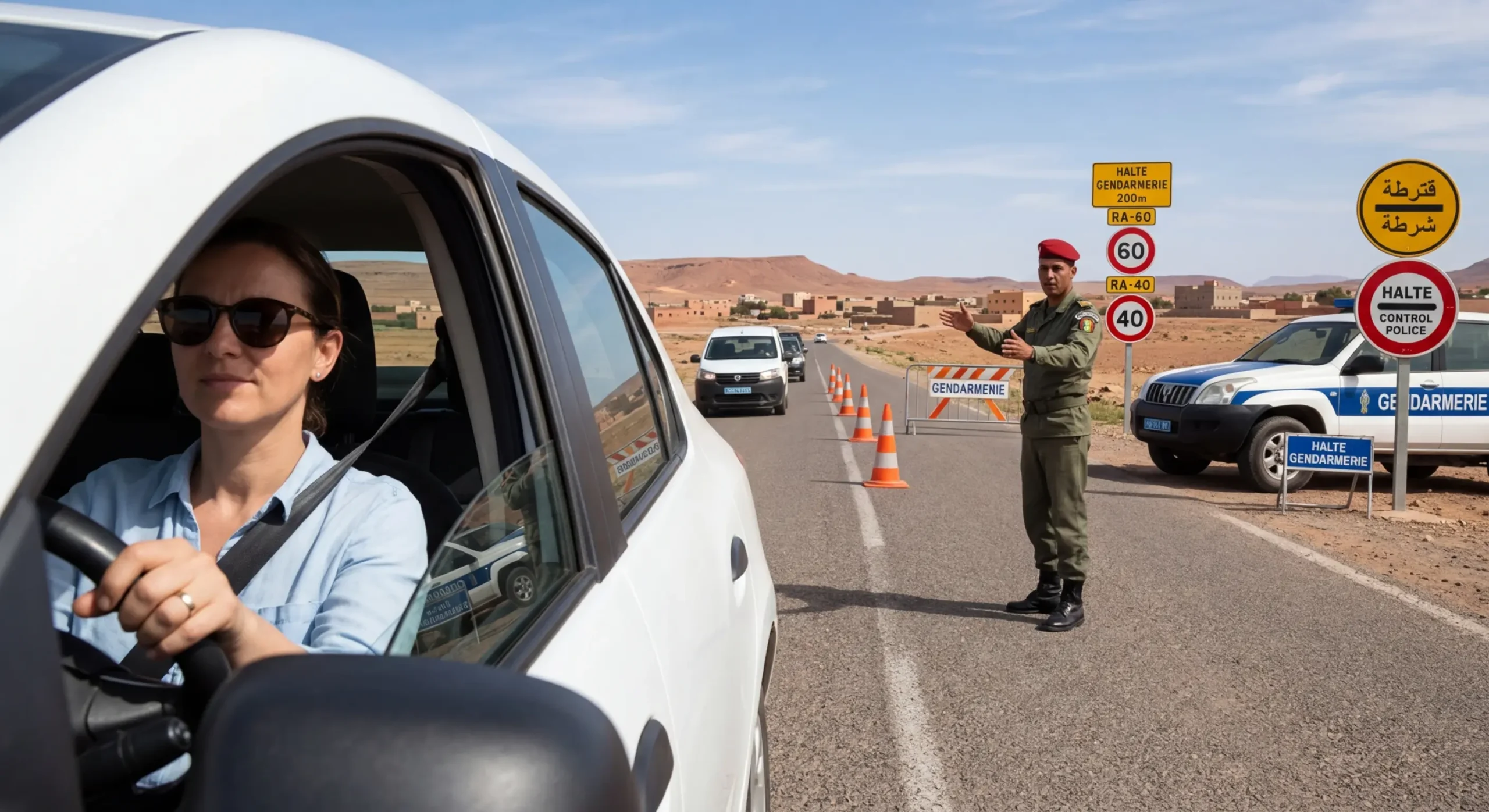
One certainty in life is that you'll be stopped by the police while driving in Morocco, as checkpoints are practically everywhere. That's not an exaggeration written to alarm you. It's an accurate description of the driving experience in Morocco that every prepared tourist should factor in before they get behind the wheel.
The good news is that checkpoints are not something to be anxious about. They're routine, professional, and for the vast majority of tourists in rental cars with correct documents and legal driving behaviour, they're resolved in under two minutes. This guide tells you exactly what to do so those two minutes are calm and quick every single time.
What You'll Learn in This Guide
- The difference between Police and Royal Gendarmerie checkpoints and where each operates
- The approach sequence that gets you through without complications
- Exactly which documents to have ready and in what order
- What officers typically ask and how to answer correctly
- The bribe question answered honestly
Police vs Royal Gendarmerie: Who You'll Meet and Where
Morocco has two main law enforcement bodies that operate checkpoints on roads relevant to tourists driving from Agadir.
Police Nationale operate primarily within city limits. In Agadir city itself, on the Corniche, around the souk, and on the main urban boulevards, you're in Police Nationale territory. Dial 19 to reach the police in urban areas.
Royal Gendarmerie operate outside city boundaries on national roads, highways, and in rural areas. The Royal Moroccan Gendarmerie is a national force tasked to ensure public safety, maintain order, and enforce laws, operating primarily outside urban centres. On the A7 highway toward Marrakech, on the N1 coastal road toward Essaouira, and on all routes through villages and open countryside, you're in Gendarmerie territory. Dial 177 for the Royal Gendarmerie outside cities.
In practice the checkpoint experience is similar with both forces. The procedural difference matters if you ever need to call for help: use 19 in a city, 177 on a rural road or highway.
How to Spot a Checkpoint Before You Reach It
Checkpoints are very common, especially at the entrances and exits of towns. You will see warning signs leading up to them.
The approach sequence is usually:
- A speed reduction sign appears, typically dropping from 100 to 60 km/h
- Further signs reduce to 40 km/h then 20 km/h in quick succession
- Orange cones or barriers narrow the road ahead
- Officers in uniform are visible at the checkpoint itself
You can also spot the police presence by the fact that cars in front of you start slowing down for no apparent reason. Following the behaviour of vehicles ahead is a useful early signal before the signs become visible. When local drivers inexplicably brake on an open road, a checkpoint is almost certainly ahead.
Approach checkpoints at a reduced speed, heeding the warnings from other drivers who might flash their lights. The headlight flash from oncoming drivers is the informal warning system that Moroccan drivers use to alert each other. When you see it, reduce speed immediately.
The Approach Sequence: Exactly What to Do
Follow this sequence every time you approach a checkpoint:
- Reduce speed progressively as soon as the first warning signs appear. Don't brake sharply at the last moment.
- Roll down your window before you reach the officer. Having the window already down signals that you're cooperative and prepared.
- Make eye contact with the officer as you approach. Many checkpoints wave tourist vehicles through quickly. Slow down as you approach, make eye contact with officers, and proceed if waved on. If the officer waves you through, proceed at low speed and don't accelerate sharply.
- If signalled to stop, pull over smoothly and completely. Switch off the engine if you'll be stationary for more than a moment.
- Stay in the vehicle unless asked to get out. Don't open the door or get out before being asked.
- Smile and greet the officer. A simple "Bonjour" or "Salam" establishes a respectful tone immediately. Always slow down immediately, roll down your window, and follow the officer's hand signals. If they signal you to stop, be polite and have your documents ready.
Which Documents to Have Ready and in What Order
Before you approach any checkpoint, these documents should be within arm's reach in the vehicle, not buried in a bag in the boot:
- Your passport
- Your original driving licence
- Your International Driving Permit if required for your nationality
- The LiloxCars rental contract
- The vehicle registration document
- The insurance certificate
Keep all your documentation with you including driving licence, rental documents, registration, and insurance while driving since there are frequent police checkpoints in Morocco, particularly along roads used by tourists.
We keep the vehicle documents in a folder in the glove box at LiloxCars. At pickup, check that the folder contains the rental contract, insurance certificate, and vehicle registration before you drive away. These are the documents you'll reach for at checkpoints. Having them in one place rather than spread across the car makes the interaction faster and calmer.
What Officers Typically Ask
The checkpoint conversation for tourists in rental cars is usually brief and follows a predictable pattern.
An officer will typically ask where you've come from and where you're going. Answer specifically. "From Agadir, going to Essaouira" is the right level of detail. Vague answers invite follow-up questions. Specific answers establish that you know your route and are driving with a clear purpose.
They may ask to see your driving licence and passport. Hand both over calmly. If you have an IDP, present it alongside your standard licence.
They may check the rental contract and vehicle registration to confirm the vehicle is properly documented. This is routine and takes under a minute.
If stopped by the police, be prepared to present your documents, including car registration and insurance, and answer their questions courteously. Fines for violations like speeding are usually paid in cash on the spot.
In some cases officers will conduct a breathalyser test. Police conduct random breath tests at checkpoints. If you're planning to drink, arrange alternative transportation. Your rental car should stay parked. Morocco operates zero tolerance on drink driving. This is not negotiable under any circumstances.
The Bribe Question: An Honest Answer
It would be dishonest to write a checkpoint guide for Morocco without addressing this directly.
Some travel forums and older guides suggest placing cash in your passport before handing it to an officer. We don't recommend this approach and we're clear about why.
Attempting to bribe a Moroccan police officer is a criminal offence. The consequences of attempting a bribe with a straightforward officer are significantly more serious than any traffic fine. The vast majority of officers conducting checkpoint stops are professional, straightforward, and simply doing their job.
Never attempt to bribe an officer. This can result in arrest. Always request a receipt.
If you've committed a genuine traffic violation and a fine is issued, pay it. Request a receipt. The fine amounts are stated clearly in law. The receipt is your documentation. This is the correct procedure and it resolves the situation cleanly.
Checkpoints at Night and on Remote Roads
Checkpoints operate at night as well as during the day, particularly on national routes between cities. Be aware that some officers only record your speed and pass it to the next checkpoint, which will stop you and issue the fine. This relay system means that a speeding incident recorded by an officer without a radar gun at one checkpoint can result in a stop and fine several kilometres later at the next one.
On remote roads after dark, checkpoints take on additional importance as security measures. Not always signed in advance. Some are signed; others are not. On rural roads at night, approach any orange cones or lights ahead at low speed and treat them as a potential checkpoint until you can confirm otherwise.
Questions We Get Asked All the Time
How many checkpoints should I expect on a drive from Agadir to Marrakech?
There are checkpoints at the entrance and exit of every town, so there are really many. On the A7 highway from Agadir to Marrakech you'll pass through toll checkpoints and Gendarmerie stops. On national routes through towns the number is higher. Expect to slow for a checkpoint of some kind every 30 to 60 kilometres on national roads outside of city areas. On the motorway they're less frequent.
What if I don't speak French or Arabic at a checkpoint?
Smile, be patient, and use gestures. Officers at tourist route checkpoints are accustomed to foreign visitors. Present your documents, point to your destination on your phone map if asked where you're going, and stay calm. Most stops resolve without requiring more than a few words.
Can officers search the vehicle at a checkpoint?
Yes. Officers have the legal authority to conduct vehicle searches at checkpoints. This is uncommon for tourists in rental cars but it does happen, particularly near border regions or areas with specific security considerations. Cooperate calmly and the process is typically brief.
What's the emergency number for the Gendarmerie if I need help on a rural road?
Dial 177 for the Royal Gendarmerie outside cities. For urban areas use 19. Save both numbers in your phone before you leave Agadir. Also keep our LiloxCars WhatsApp number accessible throughout your rental as we're available 24 hours a day.
What if an officer issues a fine I genuinely believe is wrong?
Pay the fine, request a receipt, and note the officer's details and the checkpoint location. Contest it through proper channels after the fact if necessary. Do not argue at the checkpoint. The roadside is not the place to dispute a fine, and doing so rarely produces a favourable outcome.
Checkpoints Are Part of the Drive, Not an Obstacle to It
Morocco's checkpoint system is one of the reasons its main tourist routes are among the safest roads in North Africa. Professional enforcement, consistent presence, and visible policing create road conditions that experienced Morocco drivers appreciate rather than resent.
Approach every checkpoint at low speed, window down, documents accessible, and a relaxed attitude. The stop will almost always be brief, professional, and completely unremarkable. If you want to confirm which documents you'll need for your specific rental with LiloxCars before you travel, you can send us a WhatsApp message and we'll answer directly.