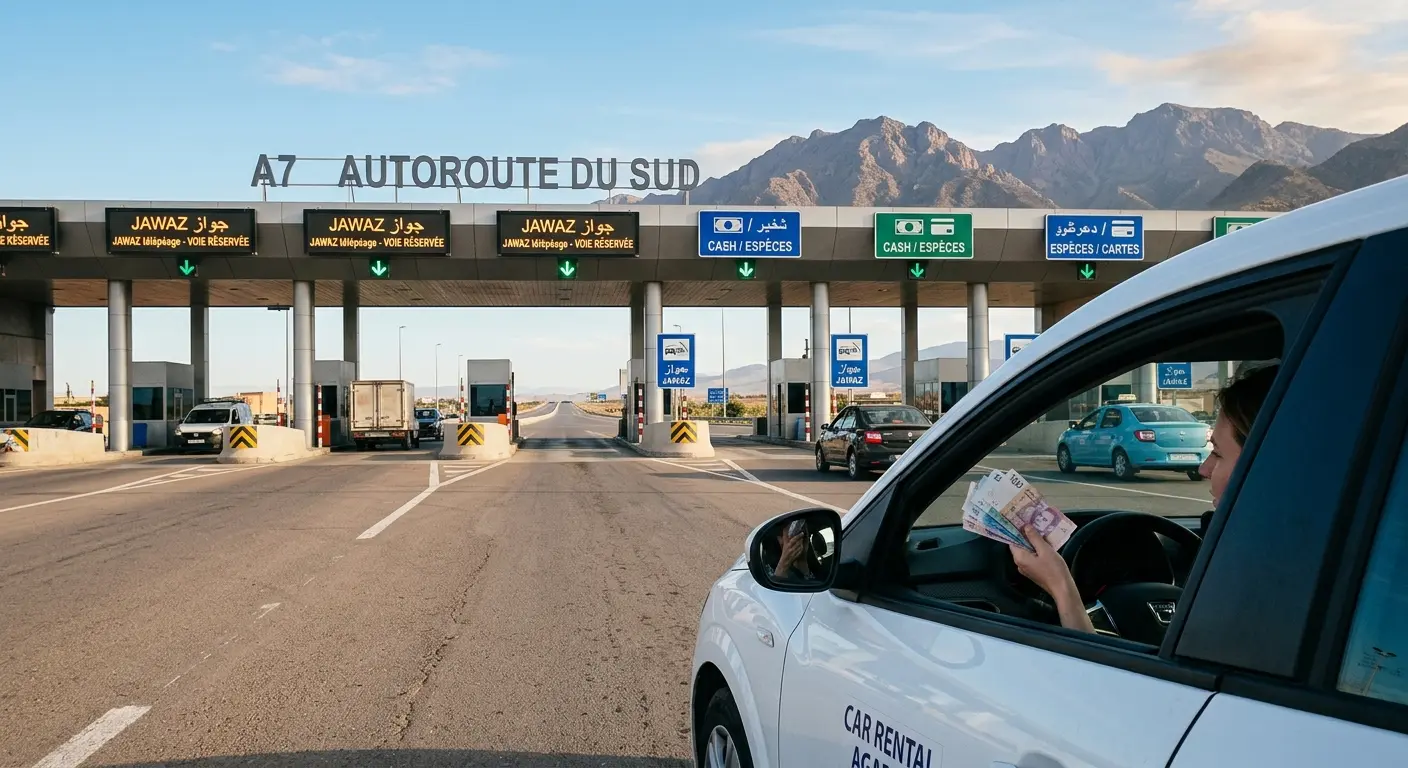
The A7 highway between Agadir and Marrakech is one of the best roads in North Africa. Smooth tarmac, consistent lane widths, dramatic Atlas Mountain scenery from the windscreen. The toll system that funds its maintenance is also one of the most straightforward in the region, but it has specific payment requirements that catch unprepared tourists at the booth.
This guide covers exactly how Morocco's autoroute toll system works, what the common routes from Agadir cost, which payment methods are accepted where, and whether the Jawaz electronic pass makes sense for a tourist rental.
What You'll Learn in This Guide
- How Morocco's distance-based closed toll system actually works
- Which autoroutes are relevant for drives from Agadir and what they cost
- The three payment methods available and where each one works
- What the Jawaz pass is, what it costs, and whether it's worth it for tourists
- The toll-free alternative routes and the trade-off involved
How Morocco's Autoroute Toll System Works
Morocco operates a closed toll system where you receive a ticket upon entry and pay based on distance traveled when exiting. This means the process at every motorway on-ramp is the same: take a ticket from the machine or attendant, keep it for your entire journey on that section, and present it at the exit booth where your fee is calculated based on how far you've driven.
Morocco's autoroutes are designated with the letter A followed by a number. All A-numbered highways in Morocco require toll payments. There are no free sections on any autoroute. The network currently covers 2,177 km nationwide, operated by the state-owned Société Nationale des Autoroutes du Maroc, known as ADM.
Rates are calculated at approximately 0.50 to 0.70 MAD per kilometre for passenger cars including 20 percent VAT. Most intercity journeys for a standard rental car fall between 20 and 80 MAD per toll section. The total toll cost for a complete Agadir to Marrakech drive across all sections typically runs between 50 and 70 MAD in each direction. Keep small dirham notes specifically for tolls throughout your trip.
U-turns are forbidden by law on autoroutes for safety reasons. If you make a U-turn, you'll be charged the toll for the longer journey and may face additional penalties.
The Routes From Agadir: What You'll Pay
The A7 is the highway that matters most for LiloxCars customers. It's the route most travellers take on the Agadir to Marrakech drive and on longer journeys toward Casablanca and beyond.
Agadir to Marrakech. The A7 section connecting Agadir to Marrakech runs approximately 230 km through the Atlas Mountains. Building works began in 2006 and it was opened in 2010. The total toll cost across the multiple booths on this section for a passenger car is typically 50 to 70 MAD in each direction. Budget 150 MAD in dirham notes to cover tolls comfortably on a return trip.
Agadir to Casablanca. The full A3 corridor from Agadir through Marrakech to Casablanca covers 429 km. Toll costs for the complete journey run between 100 and 130 MAD for a passenger car. If your itinerary includes Casablanca, plan for roughly 200 MAD in toll cash for the round trip.
Agadir to Essaouira. The coastal N1 route to Essaouira is not an autoroute and carries no toll charge. This is one of the most scenic drives from Agadir and it's entirely free of toll booths.
Agadir to Taroudant and Tiznit. These routes use national roads rather than autoroutes. No tolls apply.
Payment Methods at Toll Booths
Three payment methods are accepted at Moroccan toll booths and understanding where each works matters before you pull up to a barrier.
Cash (Moroccan Dirhams). Cash is accepted at all toll booths on the Moroccan motorway network without exception. Toll booth attendants provide change for cash payments, so exact change is not required. However, having smaller bills makes transactions faster and avoids waiting for change at busy booths. Keep a supply of 20 and 50 MAD notes in the car specifically for tolls.
Credit and debit card. Credit cards are accepted at major toll plazas but cash remains the most reliable payment method. Card acceptance is not universal across all booths on all sections. On busy main routes like the A7 near Agadir and Marrakech, card terminals are typically available. On smaller sections and more remote stretches of the network, cash is more reliable. The safe approach for tourists is to carry sufficient dirham notes and treat card payment as a bonus where available rather than a guarantee.
Jawaz electronic pass. The Jawaz is a prepaid RFID pass that allows you to drive through reserved lanes at toll booths without stopping. Jawaz customers pass through the lanes reserved for them at reduced speed without stopping to pay manually.
The Jawaz Pass: What It Is and Whether It's Worth It for Tourists
The Jawaz is Morocco's electronic toll collection system operated by ADM. It's a prepaid badge attached to your windscreen that communicates with sensors at dedicated toll lanes, deducting your toll automatically as you pass through.
The Jawaz pass costs 100 MAD to purchase from September 2024, with ADM running a summer promotion at 80 MAD from July 2025. The pass is purchased without any included credit, so you load it separately. Jawaz users often receive 5 to 10 percent discounts compared to cash rates, plus faster passage through dedicated lanes.
Jawaz cards are available to anyone at ADM sales outlets and many petrol stations without residency requirements. You can purchase a Jawaz at a Jawaz-enabled petrol station on your way onto the motorway.
Is the Jawaz worth it for a tourist rental?
For most tourists renting for a week or less, the honest answer is no. The 100 MAD purchase price plus loading credit adds friction and upfront cost to what is otherwise a simple cash transaction. The toll savings from the 5 to 10 percent discount are modest on the amounts involved. The main genuine benefit is speed through the dedicated lane, which matters more during peak season when cash lanes can have queues.
If you're doing significant highway mileage across multiple days including the Agadir to Marrakech run and further drives, the Jawaz becomes more practical. For a city-and-coast itinerary with one or two highway drives, cash is simpler and equally functional.
LiloxCars does not currently include a Jawaz pass as a standard rental extra. Cash payment at toll booths is reliable, accepted everywhere, and requires no additional setup.
The Toll-Free Alternative Routes
You can use Route Nationale N-numbered roads which are toll-free. However, journey times typically double compared to autoroutes, and road conditions vary. N-roads pass through cities and villages, while autoroutes are limited-access highways.
The N1 coastal road between Agadir and Essaouira is a strong example of a toll-free national route that's genuinely scenic and worth taking on its own merits rather than as a money-saving compromise. The drive north along the Atlantic coast offers views that the enclosed A7 motorway doesn't.
For Agadir to Marrakech, the toll-free option adds roughly an hour to the journey compared to the A7 and involves driving through numerous towns and villages rather than on an open highway. The 50 to 70 MAD toll cost on the A7 is a reasonable exchange for the time and driving quality difference.
N-numbered roads are toll-free but travel times increase by 30 to 40 percent. Rural roads may have variable conditions. That trade-off is worth understanding before you decide, but for most itineraries the autoroute toll is the right choice.
Questions We Get Asked All the Time
Do I need exact change at Moroccan toll booths?
No. Toll booth attendants provide change for cash payments. However, having smaller bills makes transactions faster and avoids waiting for change. Keep 20 and 50 MAD notes accessible specifically for toll booths.
Can I pay Agadir autoroute tolls by card throughout?
Credit cards are accepted at major toll plazas but not reliably at all booths on all sections. Always carry sufficient dirham cash as your primary payment method and treat card acceptance as a bonus where available.
Are tolls included in the LiloxCars rental rate?
No. Tolls are not included in rental car prices and are paid separately by the driver at each booth. Your LiloxCars rental rate covers the vehicle, full insurance, and unlimited mileage. Toll costs during the rental are your responsibility as the driver.
Is the Jawaz pass transferable between vehicles?
The Jawaz pass is linked to the vehicle it's attached to rather than to the driver. A pass purchased for one vehicle cannot be used in a different vehicle. If you buy a Jawaz for your rental car, it stays with that vehicle.
What if I lose the ticket received at the autoroute entry booth?
If you lose your entry ticket, you'll be charged the maximum possible toll from the farthest entry point on that autoroute section. Keep your ticket accessible throughout your journey on any autoroute section.
Budget Your Toll Costs Before You Drive
Moroccan autoroute tolls are genuinely inexpensive by any international comparison. A full Agadir to Marrakech return on the A7 costs less than a coffee at a European motorway service station. The system is straightforward, the booths are clearly signed, and cash is always accepted.
Before any highway drive from Agadir, count your dirham notes and make sure you have enough small denominations to cover the expected toll cost plus a reasonable buffer. If you want to check the specific toll cost for a route you're planning before your trip, the ADM Traffic app provides current tariff estimates for any journey on the Moroccan autoroute network. Any other questions about driving from Agadir, you can send us a WhatsApp message and we'll answer from direct local experience.